

Why the best candidates didn’t change jobs in 2025 (and why that may change in 2026)
Why so many good people didn’t change jobs in 2025 (and why that may change in 2026)
If you spent any time this year wondering why the market felt quieter than expected, you weren’t imagining it.
2025 wasn’t a year of mass resignations or frantic job hopping. In fact, many highly capable, experienced professionals made a very deliberate decision to stay exactly where they were.
That wasn’t because they were suddenly happier. It was because they were more cautious.
Staying put wasn’t fear – it was strategy
here’s a lazy assumption that people who don’t move jobs are “risk averse” or “stuck”.
That wasn’t the case in 2025.
What we saw instead were thoughtful, calculated decisions driven by a mix of economic uncertainty, fatigue from constant change, and a desire for stability - particularly among mid to senior professionals.
People asked themselves:
- Is this really the year to take a risk?
- Am I better off backing the role I know rather than the promise of something new?
- What happens if the market tightens further?
For many, staying put was the smarter option.
Market noise vs market reality
On paper, 2025 was meant to be a strong hiring year.
There was plenty of talk about skills shortages, infrastructure pipelines, energy transition, approvals pressure and talent scarcity. All true – but that didn’t automatically translate into confident hiring decisions.
Many organisations:
- Took longer to approve roles
- Reworked business cases multiple times
- Paused recruitment mid-process
- Opted for short-term fixes instead of long-term hires
Candidates noticed.
When employers hesitate, good people don’t rush to jump ship.
Counteroffers played a bigger role than usual
Another clear trend this year was the effectiveness of counteroffers.
In a tighter, more cautious market, employers worked harder to retain people they already trusted. Flexibility, small pay adjustments, retention bonuses, and promises of “things improving next year” became common.
For some candidates, those counteroffers were genuine and well thought through.
For others, they simply delayed a decision that’s still coming.
The key point is this: counteroffers worked better in 2025 than they have in previous hot markets. That alone slowed movement.
Flexibility became the real currency
Salary still matters, but flexibility quietly became the deciding factor for many professionals.
By 2025, most experienced candidates weren’t chasing the biggest package on paper. They were asking:
- Can I manage my time better?
- Will this role give me breathing space?
- Do I trust the leadership team?
Roles that offered sensible flexibility, autonomy and trust held onto people – even when the money elsewhere looked tempting.
Burnout also had a say
Another factor that doesn’t get talked about enough is simple exhaustion.
After years of disruption, restructures, COVID hangovers, project pressure and organisational change, many people just wanted a year without upheaval.
Changing jobs takes energy. Interviews, probation periods, learning new systems, proving yourself again - it all adds up.
For a lot of very capable people, 2025 became a year to consolidate rather than reset.
So why might 2026 look different?
Here’s the important part.
Most of the people who stayed put in 2025 didn’t stop thinking about change. They just postponed it.
Quietly, throughout the year, we’ve had more off-market conversations than usual with people saying:
- “Not this year, but maybe next.”
- “Let’s talk early in the new year.”
- “I’m fine for now, but I won’t be forever.”
That matters.
Because delayed movement doesn’t disappear – it bunches up.
What we’re already seeing heading into 2026
As the year winds down, a few early signals are emerging:
- Professionals reassessing roles after annual reviews
- Counteroffers wearing thin as promised changes fail to materialise
- Candidates wanting conversations before updating CVs
- Employers quietly planning replacement hires for Q1
- More discreet, relationship-driven hiring discussions
This is often how markets turn – not with a bang, but with a steady release of pent-up movement.
What this means for employers
If you’re hiring in 2026, it’s worth remembering that many candidates you’ll speak to haven’t moved in years.
- They won’t be impulsive.
- They won’t be impressed by shiny job titles.
- They’ll ask harder questions.
Clear leadership, realistic expectations, flexibility and decisiveness will matter far more than glossy promises.
And moving too slowly will cost you good people.
What this means for candidates
If you’re thinking about a move next year, you don’t need to rush - but you shouldn’t drift either.
The strongest candidates in 2026 won’t be the loudest. They’ll be the ones who:
- Understand their real market value
- Are clear on what they want (and don’t want)
- Start conversations early and discreetly
- Move with intention, not panic
You don’t need to be “job hunting” to explore options properly.
A final thought
Every recruitment cycle looks different on the surface, but the underlying behaviour rarely changes.
When uncertainty rises, good people pause.
When confidence returns, they move – often quickly.
2025 was a year of pause. 2026 is shaping up to be a year of considered action.
If you’re planning ahead, you’re already doing better than most...

This is the biggest shake-up to federal environment law since the EPBC Act came in back in 1999, and it's not a someday thing. It's happening now, and if you work in approvals, assessment or ecology, it's going to land on your desk.

Contaminated land has been steady work for years, but PFAS is the part that keeps the phone ringing. If you've got real experience here, you're in a good spot. If you're thinking about where to point your career next, it's worth understanding why.
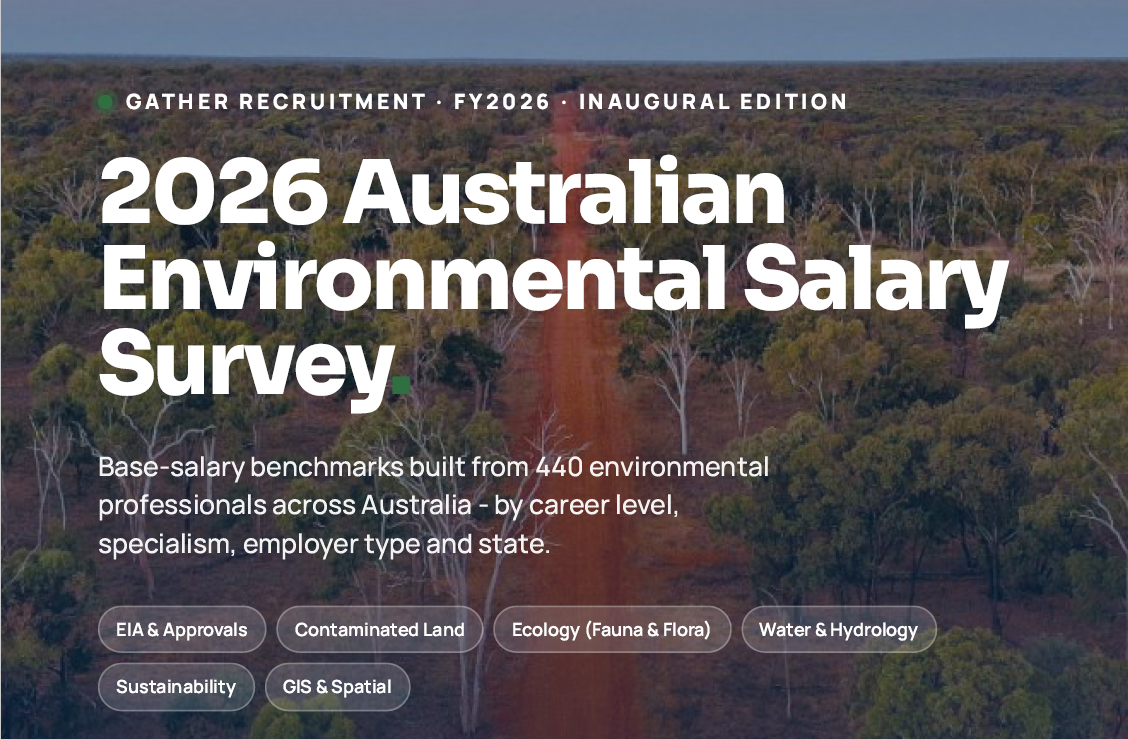
Download the 2026 Australian Environmental Salary Survey. Salary benchmarks for environmental consultants, ecologists, hydrogeologists, contaminated land specialists, approvals professionals and sustainability practitioners across Australia
